

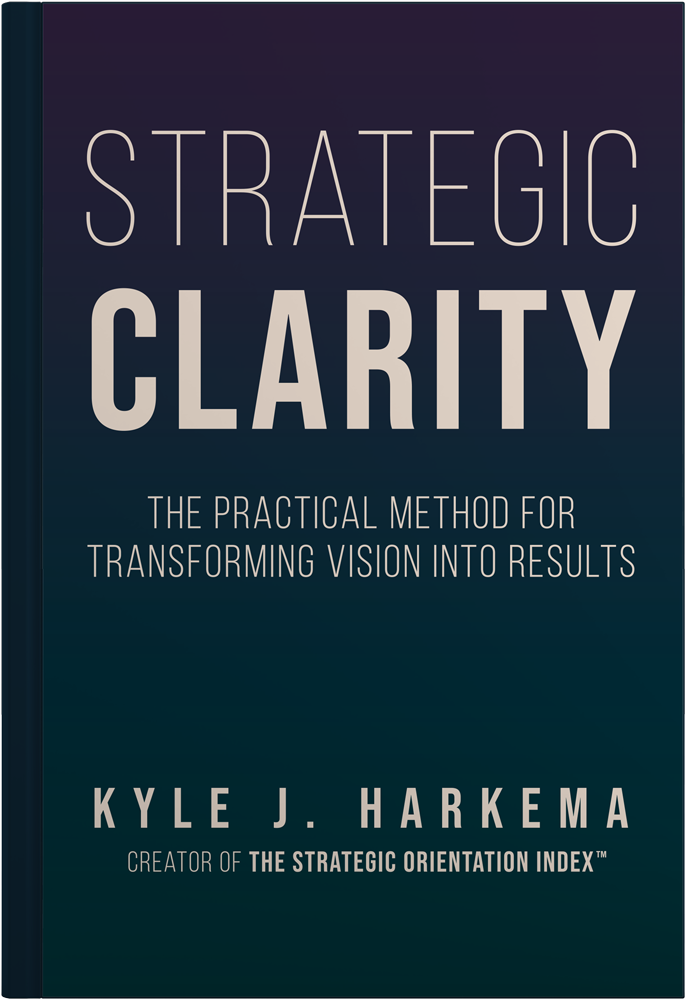
New Framework — Now Available for Pre-Order
The Strategic Orientation Index™ is the first framework to integrate entrepreneurial orientation, market orientation, and entrepreneurial marketing into a single behavioral diagnostic. Built on doctoral research and field-tested with executive teams, it gives leaders a measurable way to close the gap between strategic intent and organizational behavior.
Sound familiar?
Different departments assess risk differently. Customer input is weighted unevenly. Priorities drift. Decisions get reopened. The plan looks clear on paper—but behavior across teams doesn’t match.
This pattern isn’t a leadership failure but simply a behavioral misalignment that existing frameworks weren’t designed to detect. Until now.

About the Author
Dr. Kyle J. Harkema is a scholar-practitioner whose work sits at the intersection of strategy, entrepreneurship, and organizational behavior. His doctoral research produced the Strategic Orientation Index™—the first diagnostic framework to integrate how firms think (EO), how they listen (MO), and how they act (EM) into a single measurable system. He has applied this framework inside live enterprises, across graduate-level strategy programs, and through executive facilitation—bridging the gap between academic rigor and operational impact.
Doctor of Business Administration (DBA) & MBA. 20+ years of executive marketing leadership across industries. University-level educator and published researcher in entrepreneurial marketing, strategic decision-making, and the role of behavioral orientation in firm performance.
Vijay Govindarajan (Tuck School of Business, Dartmouth), Michael H. Morris (University of Notre Dame), Charlene Li (New York Times bestselling author), Patrick J. Murphy (University of Alabama at Birmingham), Joe LiPuma (Boston University), and validated in practice by CEOs including Mitch Kehler of KMC Controls.
Praise for Strategic Clarity

Harkema’s Strategic Clarity extends the work of gurus at the intersection of strategy content and process, combining theory with operational precision. He provides an elegant system for turning strategic intent into ubiquitous organizational behavior in a focused manner. A must read for founders and executives pursuing disciplined growth, especially in times of significant market and economic uncertainty and upheavals.
Joe LiPuma, Consultant and Clinical Associate Professor, Boston University’s Questrom School of Business
Strategic Clarity is one of those rare strategy books that actually makes complex ideas feel usable. Kyle Harkema takes big academic concepts—entrepreneurial mindset, market orientation, opportunity spotting—and breaks them down into clear, practical guidance leaders can apply right away. If you want a smarter, more grounded way to make strategic decisions without the usual buzzwords, this book is the one you’ll keep coming back to.
Dr. Marshall Goldsmith is the Thinkers50 #1 Executive Coach and New York Times bestselling author of The Earned Life, Triggers, and What Got You Here Won’t Get You There
How it Works
Learn how Entrepreneurial Orientation, Market Orientation, and Entrepreneurial Marketing interact as behavioral constructs — and why misalignment between them silently erodes execution, regardless of industry or firm size.
Use the SOI™ scoring methodology to map your organization to one of five strategic personas. Identify whether growth struggles are strategy-based or behavior-based — and where the gaps are.
Apply persona-specific playbooks to close behavioral gaps, stabilize execution, and build the conditions research consistently links to sustained growth and profitability.
Why Now
The pace of disruption has outrun the tools most organizations use to stay aligned. Traditional strategy frameworks assess where to compete and why. SOI™ assesses something they were never designed to measure: how consistently your organization interprets and enacts strategy once it’s defined. The faster your environment moves, the more expensive that inconsistency becomes.
What Changes
Alignment gaps surfaced. Decision cycles shortened. A shared language for risk and customer signal established across the leadership team.
Faster cross-functional execution. Less initiative sprawl. Fewer executive surprises. More consistent customer-informed action.
Stronger leadership trust. Disciplined risk posture. Resilience under volatility. Compounding execution velocity.
Decades of peer-reviewed research link aligned entrepreneurial and market orientation to improved growth and profitability. SOI™ strengthens the behavioral conditions those outcomes depend on — providing an empirically grounded pathway from strategic intent to organizational performance.
Frequently Asked Questions
Most execution breakdowns aren’t caused by unclear strategy.
They’re caused by inconsistent strategic interpretation across the organization.
Different departments assess risk differently. Customer input is weighted unevenly. Priorities drift. Decisions get reopened.
That variance creates drag.
Strategic Clarity gives you a structured way to measure and reduce that variance before it shows up in missed targets or leadership churn.
Most strategy frameworks focus on why and where.
SOI focuses on how.
Specifically, how your organization interprets risk, customer signal, and responsiveness once strategy is defined.
Execution breaks when interpretation varies. SOI makes that variance measurable.
It doesn’t change your strategy. It stabilizes how it’s enacted.
SOI is a behavioral diagnostic built on three research domains:
It integrates them into a single system that measures how strategy is enacted across departments and leadership levels.
I look at impact across three horizons.
Short term (0–90 days): Clarity
Exposes alignment gaps. Reduces re-opened decisions. Sharpens prioritization. Establishes shared language around risk and customer signal.
Most firms underestimate behavioral variance until it’s measured.
Medium term (3–9 months): Execution Stability
Faster cross-functional execution. Less initiative sprawl. Fewer executive surprises. More consistent customer-informed action.
Variance decreases. Execution stabilizes.
Long term (9–24 months): Strategic Coherence
Stronger leadership trust. Disciplined risk posture. Resilience under volatility. Compounding execution velocity.
Coherence is what allows strategy to scale.
Decades of research link aligned entrepreneurial and market orientation to improved growth and profitability. SOI strengthens the behavioral conditions those outcomes depend on.
No.
It is research-grounded and field-tested.
SOI has been deployed inside a live mid-market enterprise across multiple departments and leadership levels, and used in graduate-level strategy formulation settings.
It is built for operational use.
No.
Culture is broad. SOI is specific and measurable.
It focuses narrowly on how strategy is interpreted and executed — not engagement or morale.
The quadrants summarize behavioral posture:
They are not labels. They are pattern summaries of how strategic behavior clusters inside a firm.
Hybrid means mixed strategic signals.
One function pushes risk. Another resists. One team listens deeply to customers. Another prioritizes internal logic.
Hybrid isn’t failure. It’s friction.
Left unresolved, friction compounds.
SOI improves what I call Return on Behavior.
It reduces execution variance and increases customer-informed prioritization.
Financial performance typically follows behavioral stability — not as a promise, but as a consequence of coordinated execution.
If:
Those are behavioral signals. SOI provides measurement and structure.
In stable markets, misalignment hides.
In volatile markets, it compounds.
The faster your environment moves, the more expensive inconsistent strategic behavior becomes.
The book provides clarity and language.
Organizations that want precision deploy the full SOI diagnostic, followed by targeted activation tied to measured gaps.
Get notified on launch day, plus early access to SOI™ resources and research updates.